How Much Time Does a Cat Spend Grooming: Full Guide and Key Facts
Your cat may appear to groom for only a few minutes at a time, yet repeat that routine throughout the day. A quick lick after a nap, a longer cleaning session after eating, and several brief touch-ups can add up to a surprising amount of time.
If you have watched your cat suddenly spend less time cleaning—or lick one spot over and over—you may wonder whether the behavior is normal. The answer depends on the cat, the coat, the environment, and what “grooming time” actually includes.
In this guide, I’ll explain how much time does a cat spend grooming, why cats groom so often, what a normal routine looks like, and which changes should prompt a closer look or a veterinary call.
How Much Time Does a Cat Spend Grooming?
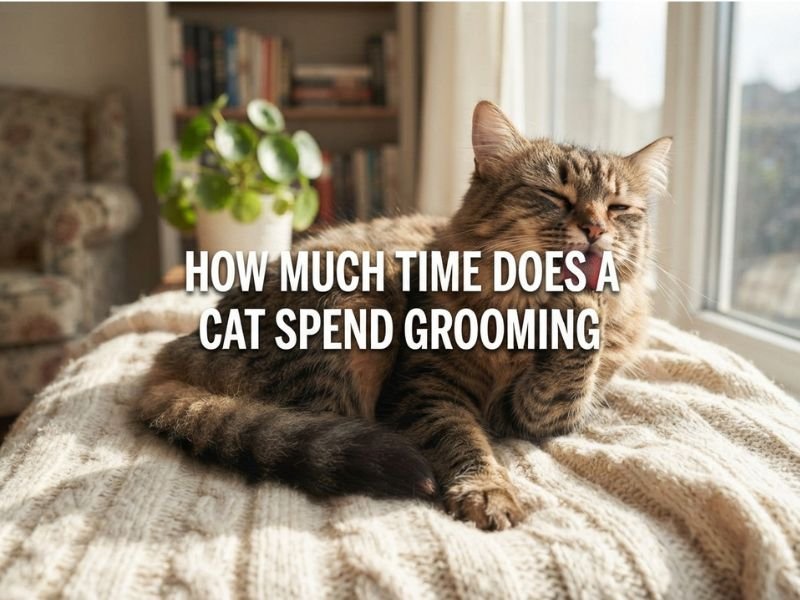
Most healthy cats spend roughly 30% to 50% of their waking time grooming, although the exact amount varies widely. For many cats, that can mean approximately 2 to 5 hours spread across the day rather than one continuous session.
That estimate is a useful general range, not a strict daily target. Cats groom in short bursts, and owners rarely observe every session. A cat may clean itself after sleeping, eating, using the litter box, playing, or encountering another cat. Some sessions last less than a minute; others continue for several minutes.
Short-haired cats often appear to groom less because their coats need less detangling. Long-haired cats may spend more time working through the coat, although some rely on a person’s brushing help. Older cats, overweight cats, painful cats, and cats with illness may groom noticeably less than they once did.
| Grooming pattern | What it may indicate |
|---|---|
| Several brief sessions throughout the day | Common, normal feline grooming behavior |
| Longer grooming after meals or naps | Routine cleaning and coat maintenance |
| Repeated licking of one area | Itching, pain, skin irritation, stress, or another medical concern |
| A sudden drop in grooming | Pain, illness, reduced mobility, obesity, stress, or weakness |
Why Cats Groom So Frequently
Grooming is much more than a beauty routine. It is a built-in maintenance behavior that supports a cat’s skin, coat, comfort, and social life.
Cleaning the coat
A cat’s tongue removes loose hair, dust, food particles, and other debris. Tiny, backward-facing structures on the tongue help pull material from the fur. This explains why cats often swallow hair while grooming and why hairballs can develop.
Grooming also helps distribute natural oils along the hair shafts. These oils can support coat condition and help the fur lie smoothly. A clean, well-maintained coat provides useful information about a cat’s general health, although appearance alone cannot rule out illness.
Regulating comfort and temperature
Cats do not cool themselves as efficiently as people do through sweating. Grooming can spread saliva over the coat, and evaporation may provide limited cooling. It is not a substitute for shade, water, or a comfortable indoor temperature, but it is part of the cat’s normal comfort behavior.
Grooming also helps a cat settle after activity. A cat may lick its paws or chest after play as part of a transition from alertness to rest.
Supporting skin awareness
The act of grooming gives a cat repeated contact with its own skin and coat. This can help it notice a burr, a tender spot, a scab, or an external parasite. However, a cat’s licking does not reliably identify the cause of a problem. Fleas, allergies, pain, infection, and stress can create similar grooming patterns.
Managing scent
Cats have a strong sense of smell, and grooming removes some food odors and environmental scents from the coat. This behavior is especially relevant to an animal that depends heavily on scent information. A cat may groom after being handled, traveling, visiting a veterinary clinic, or encountering a new smell.
Communicating socially
Some cats groom one another, a behavior called allogrooming. Friendly cats may lick the head, neck, or other hard-to-reach areas of a companion. Social grooming can reinforce relationships, although a cat that licks another cat too intensely may also be displaying tension or controlling behavior.
What a Normal Grooming Routine Looks Like
Normal grooming is usually distributed across the day and balanced across the body. A cat may begin with the face, use a dampened paw to wipe around the eyes and ears, then lick the chest, legs, sides, belly, and tail. The sequence is not identical in every cat.
A healthy grooming routine generally has these features:
- The cat grooms in multiple short sessions rather than obsessively returning to one spot.
- The coat remains reasonably clean, with no expanding bald patches or heavy matting.
- The skin is not persistently red, swollen, crusted, or moist.
- The cat can move comfortably into normal grooming positions.
- Grooming does not replace eating, sleeping, playing, exploring, or interacting.
- The pattern is fairly stable for that individual cat.
Individual variation matters more than comparing one cat with another. A quiet senior cat may groom less often than an energetic young adult and still be healthy. A long-haired cat may need more coat care from a person even if its self-grooming time seems ordinary.
Grooming after eating
Many cats clean their face and paws after a meal. Food residue around the mouth or whiskers can be uncomfortable, so a post-meal grooming session is expected. If your cat repeatedly rubs its mouth, drools, drops food, or stops eating, the behavior may point to dental or oral discomfort rather than ordinary cleaning.
Grooming after sleep
Cats often groom after waking. Sleep can flatten the coat, and a short cleaning session may help the cat become alert and comfortable. This is one reason a cat can seem to groom constantly even though each session is brief.
Grooming after using the litter box
A cat may clean its paws or rear end after using the litter box. Persistent licking around the genitals or anus, straining, frequent trips to the box, diarrhea, constipation, or an unpleasant odor deserves attention because the grooming may be responding to irritation or discomfort.
Factors That Change Grooming Time
There is no universal number of minutes that every cat should groom. My first step in evaluating a routine would be to consider the cat’s baseline and then look for a meaningful change.
Coat length and texture
Long, dense, curly, or easily tangled coats require more maintenance. A Persian, Himalayan, Maine Coon, or similar long-haired cat may spend substantial time grooming, yet self-grooming alone may not prevent mats. Short-haired cats generally have fewer tangles, but they still groom regularly.
A coat that suddenly becomes greasy, clumped, flaky, or unkempt can reflect reduced grooming, skin disease, poor nutrition, or another health issue. The coat’s condition is often more informative than a rough estimate of grooming hours.
Age
Kittens learn grooming behavior by watching and interacting with their mother. Young cats may be enthusiastic but inefficient as they develop coordination. Adult cats usually establish a stable routine.
Senior cats may groom less because arthritis, dental disease, muscle loss, reduced flexibility, or general illness makes certain positions painful. A dirty hind end or matted back in an older cat should not automatically be dismissed as “just aging.”
Body weight and mobility
Overweight cats may have difficulty reaching the lower back, abdomen, or hindquarters. Reduced access can lead to dandruff, mats, odor, and a coat that looks oily or neglected. Weight-related mobility problems can also cause a cat to stop grooming because bending and twisting hurt.
Stress and changes at home
Moving, construction noise, a new pet, conflict between cats, schedule changes, and limited hiding areas can affect grooming. Stress may cause either excessive licking or reduced self-care. Some cats develop a repetitive grooming habit as a displacement behavior, while others withdraw and stop maintaining the coat.
Weather and indoor conditions
Shedding seasons can increase the amount of loose hair a cat encounters during grooming. Dry indoor air may contribute to flaky skin, while heat can alter resting and grooming patterns. These environmental factors do not explain every change, so persistent symptoms still require evaluation.
Health status
Skin allergies, fleas, mites, bacterial or fungal infections, pain, urinary problems, digestive disease, and anxiety can all affect grooming. A cat may focus on an itchy or painful location, or it may stop grooming because it feels weak or uncomfortable.
Overgrooming: When Licking Becomes a Problem
Overgrooming means grooming intensely or repeatedly enough to damage the coat or skin. The most obvious signs include bald patches, broken hairs, redness, scabs, sores, or a wet area that never seems to dry.
Commonly affected areas include the abdomen, inner legs, flanks, back, and tail base. A cat may pull hair out with its teeth, lick until the skin is irritated, or suddenly begin grooming one location much more than usual.
Possible causes of overgrooming
- Fleas or other parasites: Even a small number of fleas can cause severe itching in a sensitive cat.
- Allergies: Food, environmental allergens, or contact irritants may trigger itching.
- Pain: Cats sometimes lick an area near a painful joint, wound, or internal problem.
- Skin infection: Infection may cause itching, odor, inflammation, discharge, or crusting.
- Stress-related behavior: Repetitive licking can become a coping habit after medical causes are considered.
- Neurologic or other disease: Less common conditions can produce unusual sensations or repetitive behavior.
Stress should not be used as the first explanation for baldness. A veterinarian should generally check for parasites, allergies, infection, pain, and other physical causes before labeling the behavior psychological.
Do not punish a cat for overgrooming or repeatedly pull it away from the area. Punishment can increase fear and tension. Instead, arrange a veterinary assessment, reduce obvious stressors, and prevent self-trauma only with safe advice from a professional.
When a Cat Grooms Too Little
Under-grooming can be subtle. A cat may continue to lick its face while neglecting the back, belly, or hindquarters. Watch for a dull or greasy coat, mats, dandruff, fecal material, bad odor, or loose hair that remains in place.
Reduced grooming can result from:
- Arthritis or another painful movement problem
- Dental pain that makes licking uncomfortable
- Obesity or limited flexibility
- Fever, weakness, nausea, or general illness
- Stress, depression-like withdrawal, or environmental insecurity
- Neurologic problems that affect coordination
A cat that suddenly looks unkempt and also hides, eats less, drinks differently, vomits, has diarrhea, loses weight, or changes litter box habits should be evaluated promptly. Grooming changes can be an early clue that something is wrong, even before more dramatic symptoms appear.
How to Track Your Cat’s Grooming Pattern
Timing every lick is unnecessary and may make a cat uncomfortable. I recommend observing the overall pattern instead of chasing a precise number.
- Establish a baseline. Note how often your cat normally grooms, which body areas receive attention, and how the coat looks.
- Look for change. Compare today’s behavior with the cat’s normal routine, not with a different cat’s routine.
- Check the skin and coat. Look for mats, bald spots, redness, scabs, parasites, odor, or moisture.
- Observe the whole cat. Appetite, energy, movement, sleep, social behavior, and litter box habits provide important context.
- Record a short video if needed. A video can help a veterinarian see the repeated licking, chewing, or posture.
Make observations without restraining the cat or interrupting every session. A relaxed cat’s normal behavior is easier to interpret than behavior changed by constant handling.
How to Help a Cat Groom Safely
Most cats do not need a bath or a complicated beauty routine. The most useful support is regular coat care, early detection of changes, and a comfortable environment.
Brush according to the coat
Short-haired cats may benefit from brushing once a week or as tolerated. Long-haired cats often need brushing several times a week, and some need daily attention to prevent mats. The right schedule depends on the coat’s density, the cat’s shedding, and how quickly tangles form.
Use a gentle brush or comb suited to the coat. Start with short sessions, reward calm behavior, and avoid forcing the process. Check behind the ears, under the front legs, around the collar, across the belly, and near the hindquarters because mats commonly develop in areas of friction.
Handle mats carefully
Do not cut a tight mat with household scissors. Cat skin can be pulled up into the mat, making accidental cuts surprisingly easy. A groomer or veterinarian can remove severe mats safely, particularly if the skin underneath is inflamed or the cat becomes aggressive from pain.
Keep the environment comfortable
Provide clean resting areas, fresh water, safe hiding places, and stable access to food and litter boxes. In a multi-cat home, distribute important resources so one cat cannot block another from eating, resting, or using the litter box. Lowering tension can help normalize stress-related grooming.
Use parasite prevention appropriately
Ask a veterinarian which flea and parasite products are safe for your cat. Never apply a dog product to a cat unless a veterinarian specifically confirms that it is safe. Some ingredients used in dog products can be dangerous or fatal to cats.
Know when bathing is appropriate
Healthy cats usually keep themselves clean without routine bathing. A bath may be necessary after exposure to a substance, for a medical skin condition, or when a veterinarian recommends it. Use only a cat-safe product and follow professional instructions. Human shampoo can irritate feline skin or leave residues that a cat later ingests while grooming.
Common Grooming Mistakes to Avoid
- Assuming more grooming is always healthier: Excessive licking can damage skin and hide an underlying problem.
- Waiting for obvious baldness: A change in frequency, posture, or target area may appear before hair loss.
- Blaming stress too quickly: Physical causes should be considered before treating repetitive licking as behavioral.
- Using essential oils or human products: Some substances are irritating or toxic when cats absorb or ingest them.
- Forcing brushing: Struggling can create fear and make future handling more difficult.
- Removing every hairball concern from the conversation: Occasional hairballs can occur, but frequent vomiting, repeated retching, constipation, or appetite loss needs veterinary attention.
- Ignoring a senior cat’s coat change: A decline in grooming can be a pain or illness signal rather than a harmless age-related quirk.
When to Contact a Veterinarian
Contact a veterinarian if grooming changes are sudden, persistent, or accompanied by visible skin damage. A professional examination is especially important when a cat develops bald patches, bleeding, open sores, swelling, discharge, severe itching, or a foul smell.
Seek prompt advice for a cat that stops grooming and also shows low energy, poor appetite, vomiting, diarrhea, weight loss, painful movement, difficulty urinating, or unusual hiding. Difficulty urinating, breathing trouble, collapse, poisoning, or severe injury requires urgent veterinary care rather than routine observation.
A veterinarian may examine the skin, mouth, joints, abdomen, and overall condition. Depending on the findings, testing for parasites, infection, allergies, pain, or other illness may be appropriate. Treatment works best when it addresses the cause rather than simply stopping the licking.
Frequently Asked Questions
Is it normal for a cat to groom for several hours a day?
Yes. Many cats spread roughly 2 to 5 hours of grooming across the day, often in short sessions. The exact amount varies by coat, age, health, stress level, and individual personality. A stable pattern with healthy skin and coat is usually more reassuring than a particular time total.
Do cats groom more than dogs?
As a general behavioral pattern, cats devote more of their waking time to self-grooming than many dogs do. Cats are highly self-maintaining animals and commonly groom after sleeping, eating, playing, and using the litter box. Individual dogs and cats still vary considerably.
Why does my cat groom immediately after I pet it?
Your cat may be restoring the coat’s position, removing unfamiliar scents, or simply following its normal grooming routine. Some cats also groom after an exciting interaction as a calming behavior. If the licking is intense, directed at one spot, or accompanied by skin damage, look for a medical or stress-related cause.
How can I tell normal grooming from overgrooming?
Normal grooming is balanced across the body and does not injure the skin. Overgrooming is more likely when a cat repeatedly targets one area, breaks hairs, creates bald patches, develops redness or sores, or spends so much time licking that normal activities are disrupted.
Why has my older cat stopped grooming?
Older cats may groom less because arthritis, dental pain, obesity, weakness, or another illness makes grooming difficult or uncomfortable. A coat that becomes matted, greasy, or dirty should be discussed with a veterinarian, particularly if the change is new.
Can brushing reduce the amount of hair my cat swallows?
Regular brushing removes some loose hair before the cat can ingest it, especially during heavy shedding. It cannot eliminate swallowed hair or guarantee that hairballs will stop. Brush gently and choose a schedule and tool that suit the cat’s coat and tolerance.
Should I bathe a cat that is grooming less?
Not automatically. A bath may clean the coat temporarily but will not correct pain, illness, obesity, or stress causing the reduced grooming. Ask a veterinarian about the underlying change first, and use bathing only when it is safe and appropriate.
Is frequent grooming always caused by fleas?
No. Fleas are a common possibility, but allergies, skin infection, pain, parasites other than fleas, and stress can produce similar behavior. A cat can have fleas without an owner seeing them, so veterinary guidance is useful when itching or hair loss continues.
Conclusion
So how much time does a cat spend grooming A healthy cat commonly grooms for about 2 to 5 hours spread across the day but the normal range is broad I would focus less on.