How to Measure a Dog: Clear Instructions and Common Mistakes
Many people assume a dog’s size is simply its weight or the number printed on a breed chart. In practice, the measurements that matter depend on the decision: a harness needs chest and neck dimensions, a crate needs body length and standing height, and a breed comparison usually uses height at the shoulder.
I use a soft measuring tape, a calm helper when possible, and a level floor to get more useful results. Knowing how to measure a dog correctly can help you choose equipment, track growth, prepare for travel, or give a groomer, veterinarian, or breeder accurate information.
The instructions below explain exactly where each measurement starts and ends, how to keep a dog in the right position, and which common shortcuts produce unreliable numbers. I also cover what to do when a dog moves, has thick fur, or falls between product sizes.
What to Measure on a Dog
Dog measurements are not interchangeable. A dog may be tall but narrow, short but deep-chested, or long-backed despite having an average height. Before measuring, identify the dimensions needed for the task.
- Height: Floor to the highest point of the shoulder blades, called the withers.
- Body length: From the front of the chest to the rear of the body, usually near the base of the tail.
- Chest girth: Around the deepest part of the rib cage.
- Neck circumference: Around the area where a collar will sit.
- Head circumference: Around the widest part of the head, when required for a harness, muzzle, or medical device.
- Weight: A separate measurement that should be taken with a scale, not estimated from body size.
Manufacturers may define their sizing points differently. A crate company might ask for nose-to-tail length, while a harness company may measure behind the front legs. I always compare my measurements with the product’s own size chart rather than assuming that one brand’s “medium” matches another brand’s size.
How to Measure a Dog for Accurate Results
Gather the right tools
A flexible cloth tape measure is the most useful tool because it follows the dog’s curves. A rigid ruler or construction tape can work for height, but it is awkward around the chest and neck. I also recommend a flat book, pencil, treats, and a second person if the dog is restless.
Use a level, non-slip surface. A hardwood floor, tile floor, or smooth concrete area usually makes positioning easier than a soft rug. Keep the tape level and snug, but do not pull it tightly enough to compress fur or skin.
Prepare the dog
Let the dog sniff the tape before placing it around the body. Reward calm standing, and take several short measurements instead of forcing the dog to stay still for a long session. A helper can offer treats while I position the tape, especially with puppies or dogs that dislike handling.
Remove bulky clothing, sweaters, and harnesses unless the measurement is specifically meant to account for them. For a thick-coated dog, press the tape through the coat until it reaches the body without flattening the coat aggressively. If the dog has unusual swelling, pain, or a recent injury, stop and ask a veterinarian before handling the area.
Keep the dog standing naturally
The most reliable position is a natural standing posture with all four paws on the floor. The legs should be reasonably straight, the head in a neutral position, and the back neither hunched nor stretched forward. Do not measure while the dog is sitting or lying down.
Ask the dog to stand squarely rather than leaning into a person or shifting weight from one side to another. A relaxed posture is more useful than an artificially rigid show stance for everyday equipment. If I am measuring a puppy, I repeat the process two or three times and record the consistent result.
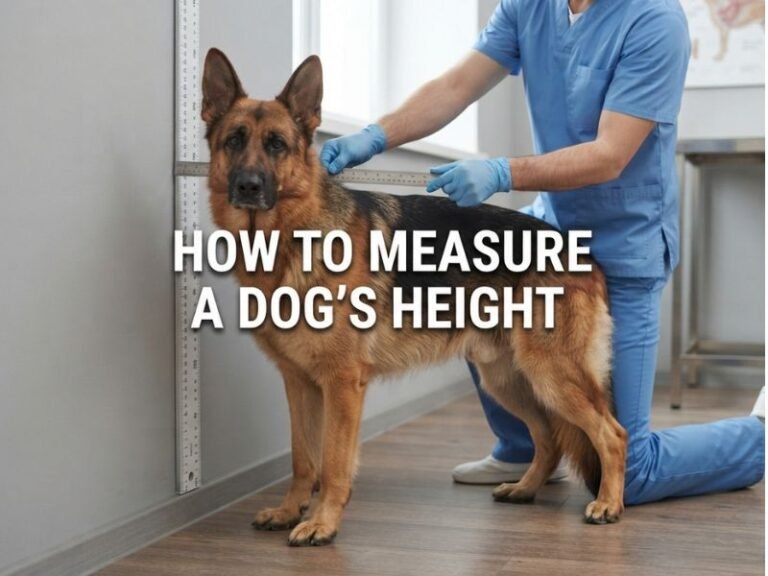
How to Measure a Dog’s Height
Dog height is measured from the ground to the withers, the highest point of the shoulder blades. It is not measured to the top of the head, ears, or neck. This standard allows dogs with different ear shapes and head positions to be compared fairly.
- Place the dog on a level surface with the front legs straight and the paws flat.
- Find the withers by feeling for the top of the shoulder blades where the neck meets the back.
- Place a flat book or carpenter’s square horizontally across the withers.
- Mark or observe where the book meets a wall.
- Measure vertically from the floor to that point.
- Repeat the measurement once or twice and record the closest consistent number.
If the dog will not stand beside a wall, I place the book directly on the withers and measure from the floor to the underside of the book. A helper should keep the book level without pressing down on the dog.
For breed standards, use the measuring method required by the relevant kennel organization. A casual home measurement can be close, but an official conformation measurement may use specialized equipment and specific positioning rules.
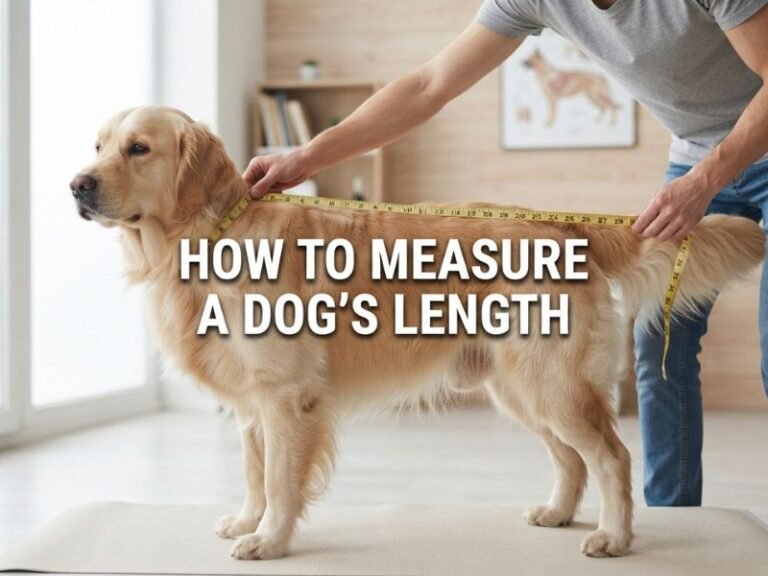
How to Measure a Dog’s Length
Body length is usually measured from the front of the chest to the rear of the body. For a crate, bed, sweater, or coat, the exact endpoints can vary, so check the instructions before measuring.
- Have the dog stand naturally on a level surface.
- Place the end of the tape at the front-most point of the chest, between or slightly ahead of the front legs.
- Run the tape along the side of the body, keeping it straight and level.
- Measure to the rear of the body near the base of the tail.
- Do not include the tail unless the product instructions specifically request total nose-to-tail length.
A long-backed dog may need a larger crate or garment even if its height falls within a smaller size range. For clothing, I may also measure from the base of the neck to the base of the tail because many coats use that back-length measurement instead of total chest-to-rump length.
Do not stretch the dog forward to create a longer measurement. That position can overstate the length and lead to an uncomfortable fit. A natural stance provides a better everyday reference.
How to Measure Chest Girth
Chest girth is the circumference around the deepest part of the rib cage. It is often the most important measurement for harnesses, life jackets, coats, and some mobility products.
- Stand beside the dog while it is relaxed.
- Wrap the tape around the rib cage immediately behind the front legs.
- Pass the tape across the broadest or deepest part of the chest.
- Keep the tape horizontal rather than letting it angle toward the stomach.
- Allow enough room for normal breathing without leaving a loose gap.
The tape should touch the coat or body lightly. I can usually slide one or two fingers beneath it, although the correct allowance depends on the product. A harness may need a secure fit, while a winter coat may require extra room for fur or a base layer.
Measure when the dog is breathing normally. Taking the reading during a deep inhale or while the dog is panting can change the result. For a deep-chested breed, check that the tape follows the rib cage instead of cutting diagonally upward behind the front legs.
How to Measure a Dog’s Neck
Neck circumference should match the location where the collar, coat, or harness strap will rest. A collar measurement is normally taken low on the neck, close to the shoulders, unless the collar is designed to sit higher.
- Place the tape around the lower or intended collar area of the neck.
- Keep it level and flat against the coat.
- Leave enough space for comfort and normal movement.
- Read the measurement without tightening the tape.
For a collar, use the manufacturer’s fit guidance after measuring. A collar should be secure enough that the dog cannot slip out, but it should not restrict breathing, swallowing, or neck movement. A commonly used comfort check is whether two fingers can fit between the collar and the dog’s neck; however, the appropriate fit depends on the dog, collar design, and safety instructions.
Do not measure around a collar that is already attached unless the product specifically says to measure over it. Thick fur can also make a collar appear looser than it is, so check the fit by hand after putting the collar on.
How to Measure for a Harness
A harness commonly requires chest girth, neck circumference, and sometimes body length. The most important number is often the chest measurement behind the front legs, but the product’s diagram takes priority.
Read the size chart before measuring because one design may measure the neck near the shoulders while another uses the upper chest. Step-in harnesses, no-pull harnesses, vest harnesses, and mobility harnesses can all fit differently.
Check the finished fit
After selecting a size, place the harness on the dog and inspect several points:
- The straps should not press into the throat or rub behind the front legs.
- The dog should be able to walk, sit, lie down, and turn the head freely.
- The harness should not rotate excessively around the torso.
- Buckles and adjustment points should not rest directly on sensitive joints.
- The dog should not be able to back out of the harness during ordinary movement.
Measure again if the dog gains or loses weight, grows through adolescence, develops a thicker coat, or changes body condition. A harness that fit a puppy several months ago may no longer sit safely.
How to Measure a Dog for a Crate, Bed, or Coat
Crate dimensions
For a crate, measure the dog’s standing height from the floor to the top of the head or ears, whichever is higher in the dog’s normal upright posture. This is different from the formal shoulder-height measurement. Then measure body length from the nose to the base of the tail.
Add enough room for the dog to stand, turn around, sit comfortably, and lie down in a normal position. A crate should not be so large that it prevents comfortable movement, but it should not force the dog to crouch or curl tightly. For a growing puppy, a crate with a divider can provide an adjustable interior.
Dog beds
Measure from the dog’s nose to the base of the tail, then consider how the dog sleeps. A dog that stretches out may need a longer bed than a dog that normally curls up. Add space for natural movement rather than choosing a bed based only on weight.
For a bolster bed, include the raised edges in the usable space. If the listed dimensions are exterior dimensions, the sleeping area may be smaller than the number suggests.
Coats and sweaters
Dog clothing often uses back length, chest girth, and neck size. Measure from the base of the neck to the base of the tail, not from the top of the head. Check whether the coat chart asks for the dog’s measurement or the garment’s finished measurement.
Leave room for normal breathing and movement. A coat that is too tight around the chest or armpits can restrict movement and cause rubbing. A coat that is too long may interfere with urination or become caught under the hind legs.
Measuring a Dog for a Muzzle or Medical Item
A muzzle requires more than a single neck or snout measurement. Depending on the design, you may need snout length, snout circumference, head circumference, and neck circumference. Follow the manufacturer’s diagram exactly because the measuring points differ between basket muzzles, grooming muzzles, and veterinary recovery products.
A dog should be able to breathe, pant, drink when the design allows it, and open the mouth appropriately in a properly fitted basket muzzle. A soft grooming muzzle is not intended for extended wear or unrestricted panting. For a medical brace, wheelchair, protective boot, or other specialized item, ask a veterinarian or qualified professional to confirm the fit.
If a dog reacts with pain, persistent distress, breathing difficulty, or sudden resistance during measuring, stop. Accurate numbers are not worth forcing a painful body part into position.
How to Measure a Puppy as It Grows
Puppy measurements change quickly, especially during the first year. Keep a simple record with the date, weight, height, chest girth, and body length. Consistent notes make it easier to choose replacement equipment and recognize changes over time.
Use the same surface and method each time. Measure before feeding or exercise when the puppy is calm, and take two readings if the puppy is wiggly. A small difference between readings is normal; a large difference usually signals movement, a slanted tape, or a different measuring point.
Do not assume an adult size from a puppy’s current measurements. Breed, sex, genetics, nutrition, and individual development all affect final size. Product sizing should be based on the puppy’s current body and expected growth allowance, not on a guess that a puppy will eventually become a certain size.
Common Dog Measurement Mistakes
Measuring to the ears
Measuring height to the ears exaggerates a dog’s formal height and changes whenever the ears move. Use the withers for shoulder height, and use the top of the head or ears only when a crate or doorway measurement requires upright clearance.
Using a tight tape
A tightly pulled tape produces a smaller chest or neck measurement than the dog actually needs. It can also flatten long fur. Keep the tape snug enough to stay in place but loose enough to reflect comfortable movement and breathing.
Measuring while sitting
A sitting dog changes the angle and shape of the chest, back, and neck. Encourage a natural stand. If the dog will not stand safely, record that limitation and use the product’s fitting support rather than forcing the posture.
Following the wrong size chart
Different brands use different terms and endpoints. “Length” may mean back length, chest-to-rump length, or nose-to-tail length. Always read the diagram and compare every required measurement.
Ignoring body shape
Two dogs can share the same weight but need different equipment because their proportions differ. A narrow sighthound, a broad bulldog, and a deep-chested shepherd may all require different harness shapes even when a chart places them in the same weight category.
Relying on one measurement
Weight alone cannot determine collar, harness, crate, or coat fit. Measure the dimensions named by the product and use weight only as an additional safety reference.
What to Do When Measurements Fall Between Sizes
Start by checking whether the product allows adjustment. For collars and harnesses, the dog’s chest and neck measurements should usually fall within the adjustable range without placing a buckle at the end of its track. For coats and boots, the larger size may be more comfortable, but excess material should not create a tripping or snagging hazard.
Look at the manufacturer’s priority instructions. Some charts say to choose by chest girth first; others prioritize weight or back length. If one measurement is outside the chart while the others fit, contact the manufacturer instead of guessing.
When safety is involved, such as a car restraint, life jacket, muzzle, or mobility aid, a professional fitting is preferable. A product that appears close enough may fail under movement, water, sudden pulling, or an emergency.
Frequently Asked Questions
Where do I measure a dog’s height?
Measure from the floor to the top of the withers, which is the highest point of the shoulder blades. Keep the dog standing naturally on a level surface. Do not measure to the head or ears unless you are checking clearance for a crate or doorway.
How do I measure a dog’s length?
Measure along the side of a standing dog from the front of the chest to the rear of the body near the base of the tail. Do not include the tail unless the product specifically requests nose-to-tail length. For coats, the chart may instead ask for back length from the base of the neck to the base of the tail.
What is the correct way to measure a dog’s chest?
Wrap a flexible tape around the deepest part of the rib cage, immediately behind the front legs. Keep the tape level, snug, and loose enough for normal breathing. This measurement is commonly called chest girth or rib-cage circumference.
Can I measure a dog while it is sitting?
For accurate height, length, chest, and neck measurements, a natural standing position is better. Sitting changes the dog’s posture and can distort the result. If standing is unsafe or impossible, ask the product manufacturer or a veterinary professional for an alternative fitting method.
Should dog measurements include thick fur?
Measure through the fur to the body without crushing the coat. The tape should lie close enough to represent the dog’s actual shape, but it should not be pulled tight. For clothing or harnesses worn over substantial fur, follow the product’s instructions about adding room.
How often should I remeasure a dog?
Remeasure after noticeable weight change, during puppy growth, after a major coat change, or whenever equipment no longer fits normally. Check high-safety items more often than decorative clothing, especially if the dog is still growing.
Conclusion
Accurate measurements begin with the correct reference points the withers for height the chest for girth the intended collar area for neck size and the body rather than the tail for most length measurements I get the most dependable results by measuring a calm naturally standing dog twice and then comparing every number with the product s own chart With that approach how to measure a dog becomes a straightforward.