How to Size Dog Clothes: Setup Steps and Troubleshooting Tips
A winter coat can look perfect on a product photo and still leave a dog unable to walk comfortably A sweater that seems roomy may twist around the.
I use three basic measurements to make clothing choices more predictable: neck circumference, chest girth, and back length. Learning how to size dog clothes also means understanding garment cut, fabric stretch, breed shape, and the difference between a snug fit and a restrictive one.
The steps below explain how to measure a dog, compare measurements with a brand’s chart, select clothing for different body types, and troubleshoot common problems. I also cover fit checks, puppy sizing, online shopping, and safety signs that mean a garment should be removed.
What dog clothing size actually means
Dog clothing sizes are not standardized across all brands. A small in one company may fit like an extra-small or medium somewhere else. Size labels are only starting points; the manufacturer’s measurement chart is more useful than the name printed on the tag.
Most charts rely on three measurements:
- Neck circumference: the measurement around the base of the neck where a collar normally rests.
- Chest girth: the measurement around the deepest part of the rib cage, usually just behind the front legs.
- Back length: the distance from the base of the neck to the base of the tail.
Some brands also list weight, waist circumference, leg length, or a recommended breed range. These details can help, but body measurements should usually carry more weight than an estimated weight range. Two dogs with the same weight can have very different chests, backs, and proportions.
Clothing size also depends on the garment itself. A stretchy knit sweater can accommodate a small range of measurements. A structured raincoat, insulated parka, or costume with fixed seams generally needs closer sizing. A dog may wear different sizes in different types of clothing without anything being wrong.
How to measure a dog for clothes
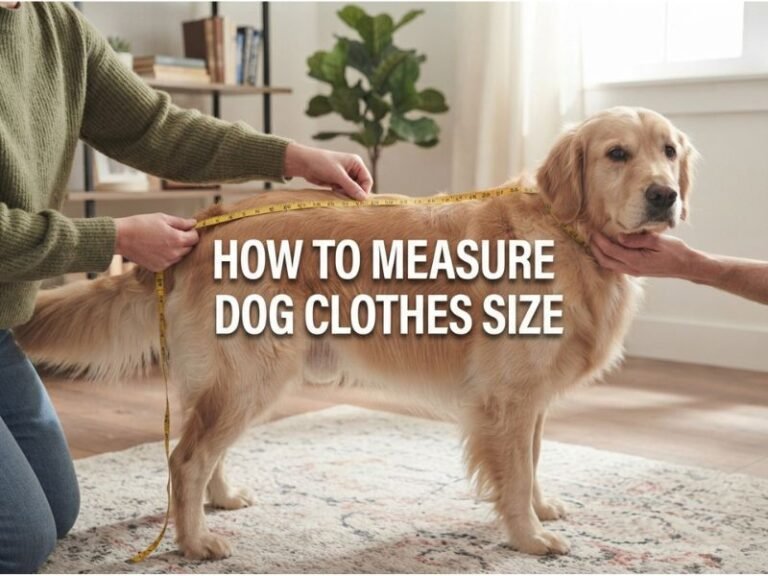
I recommend measuring a dog while the dog is standing naturally on a level surface. Standing shows the body shape that the garment must accommodate. Sitting, lying down, or stretching can change the measurements and produce a misleading result.
Gather the right tools
- A soft, flexible tape measure used for sewing is best.
- A piece of string and a ruler can work if a tape measure is unavailable.
- A notepad or phone helps record the numbers immediately.
- Small treats can help a restless dog remain still.
Keep the tape flat against the coat without digging into the fur. For a very fluffy dog, press gently through the hair to estimate the body rather than measuring a large layer of loose fur. Do not pull the tape tight enough to compress the chest or neck.
Measure the neck
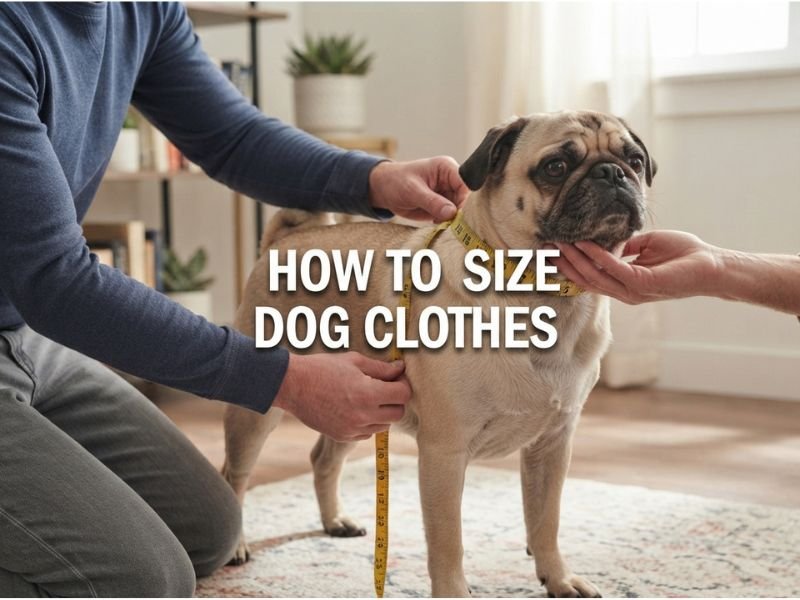
Place the tape around the lower part of the neck, near the base where the shoulders begin. This is usually lower than the position used for a decorative collar. Keep one or two fingers between the tape and the dog’s neck while measuring.
The finished garment may have a turtleneck, hood, collar, or a wide opening instead of a close neckband. A high-neck design should not be selected from the neck measurement alone. Check the product’s opening style and make sure the dog can turn the head, swallow, and breathe normally.
Measure the chest girth
Wrap the tape around the deepest part of the rib cage, immediately behind the front legs. On many dogs, this is the largest measurement around the body and the most important one for jackets, coats, and sweaters.
Make sure the tape stays level from the back to the underside of the chest. A tape that slopes upward or sits too far back can make the girth appear smaller than it really is. For deep-chested breeds, take an extra measurement to confirm the tape is positioned at the widest point.
Measure the back length
Have the dog stand with the head in a neutral position Start at the base of the neck where the neck meets the shoulders and run the tape.
Back-length conventions vary. Some companies measure from the collar area, some from the shoulder blades, and some use a general neck-to-tail measurement. Read the chart instructions carefully before comparing your number. If the dog has a very broad neck or a sloping back, the garment’s cut may matter as much as the listed length.
Repeat important measurements
I would measure each area twice, especially if the dog moved during the first attempt. Record the larger reliable number rather than averaging a clearly inaccurate measurement with a good one. Measuring before every major clothing purchase is worthwhile because weight, coat thickness, age, and muscle condition can change the fit.
How to use a dog clothing size chart
After measuring, find the brand’s chart for the exact garment. Do not assume that a chart for a sweater also applies perfectly to a raincoat from the same company. Different designs may use different cuts, fabrics, and sizing assumptions.
Compare all available measurements in this order:
- Check the chest or girth range, because a garment that cannot close around the rib cage will not work.
- Check the neck range to avoid pressure or an opening that slips over the head.
- Check the back length to see whether the garment protects enough of the body without extending over the tail.
- Review the product notes for stretch, breed shape, adjustable straps, and fit preference.
If one measurement places the dog in a different size from the others do not automatically choose the average size Identify which measurement is most restrictive for that.
For a dog between sizes the larger size is often the safer starting point when the garment has adjustable straps hook-and-loop closures or elastic panels A larger garment.
| Measurement result | Likely sizing action |
|---|---|
| All measurements fit one size | Start with that size and confirm the garment’s intended fit. |
| Chest is in the larger size | Usually prioritize the larger chest range, especially for closed coats. |
| Neck is larger but the body fits | Look for a wide opening, adjustable neckline, or a different design. |
| Back is longer than the chart range | Consider a long-body style rather than sizing up excessively. |
| Measurements fall just outside the chart | Contact the seller or choose a brand with adjustable or custom sizing. |
Choose the right fit for the garment
A dog garment should sit close enough to stay in place but loose enough to allow normal movement and breathing. I check the fit while the dog stands, walks, sits, turns, and lies down. A garment that looks fine while standing may pull across the shoulders when the dog takes a step.
Sweaters and shirts
Soft sweaters and shirts can have a little flexibility, particularly if they contain knit fabric or a small amount of stretch. The fabric should not roll tightly around the neck, pinch behind the front legs, or pull across the chest.
Check the arm openings carefully. They should leave room for the front legs to move forward without rubbing the armpits. A shirt that is too long may bunch under the belly or interfere with urination, especially on male dogs.
Raincoats
Raincoats should cover the back and sides while leaving enough clearance for bathroom use. Waterproof material often stretches less than fleece or jersey fabric, so the chest measurement becomes especially important.
Look for adjustable belly straps and closures that do not sit directly in the armpits. A hood should never block vision or hearing. If the coat has leg loops, test them during walking because they may twist or pull as the dog moves.
Insulated winter coats
Winter coats need room for the dog to move, but excessive looseness can let cold air enter and cause the coat to shift. Consider the thickness of the dog’s natural coat and whether another layer will be worn underneath.
Bulky insulation can make a coat fit smaller than its flat measurements suggest. If the dog is between sizes, compare the coat’s actual closure range and chest design rather than relying only on the size label. A coat should not flatten the neck, restrict shoulder movement, or press into the abdomen.
Boots and paw coverings
Boot sizing usually depends on paw width or paw length rather than neck, chest, and back measurements. Place the paw on paper while the dog is standing, mark the front and sides, and measure the widest part according to the manufacturer’s instructions.
Try boots indoors for a short period. They should remain secure without squeezing the toes or rubbing the dewclaw. A dog may walk awkwardly at first, but persistent slipping, licking, limping, or refusal to bear weight indicates a poor fit or poor tolerance.
Account for body shape and breed differences
Two dogs with identical girth measurements may need different clothing because their proportions are not the same. A stocky bulldog, narrow greyhound, long-backed dachshund, and small deep-chested terrier place pressure on different parts of a garment.
Long-backed dogs
Long-bodied dogs may need extra back coverage without extra width around the chest. Sizing up can provide length but leave the neck, belly, and leg openings too loose. Search for long-body or dachshund-friendly designs when available.
Deep-chested dogs
Dogs with a deep rib cage can exceed a chart’s chest range even when the neck and back measurements look ordinary. Prioritize a garment that accommodates the widest part of the chest and has a flexible or adjustable closure.
Broad-necked or muscular dogs
A dog with a wide neck and shoulders may need a larger size through the front than the back-length number suggests. Pullover designs can be difficult if the head opening is small. A coat with a full-length zipper or adjustable front closure may be easier to fit.
Hairless, shaved, or very fluffy dogs
Coat thickness affects comfort and fit. A fluffy dog may need extra room, while a hairless or recently shaved dog may need soft seams and protection from exposed fasteners. Do not measure only the fur’s outer surface, but do account for dense coat compression and any clothing layer underneath.
Perform a complete fit check
Once the garment is on, inspect the dog from several angles. The fabric should lie flat without twisting, and closures should remain in their intended position. Check the neck, chest, shoulders, belly, tail area, and legs rather than judging the fit from the back alone.
- You should be able to slide two fingers beneath a non-stretch neckline or strap without forcing them.
- The dog should take full steps without the garment pulling the shoulders backward.
- The chest closure should not press into the elbows or armpits.
- The belly area should stay clear of urine and stool.
- The garment should not cover the eyes, block the ears, or restrict the mouth.
- The dog should be able to sit, lie down, turn around, and relieve itself normally.
Watch the dog walk for a few minutes in a safe indoor area. Look for repeated scratching, biting at the fabric, freezing, hunched posture, shortened steps, or attempts to remove the clothing. Some dogs need gradual introduction, but discomfort should not be dismissed as simple resistance.
Remove clothing immediately if breathing appears difficult, the dog overheats, the skin becomes red, or a limb becomes caught. Never leave a dog unattended in a garment that can snag, tighten, or be chewed apart. Clothing should support comfort and protection, not create a new hazard.
Troubleshoot common sizing problems
The chest fits, but the back is too short
This often happens with long-backed dogs or garments cut for compact bodies. Do not solve the problem by moving to a much larger size if the neck and chest become loose. Instead, look for a longer style, a coat with an extended back panel, or a design with adjustable coverage.
The back fits, but the chest is too tight
The garment is too small for the dog’s rib cage, even if the length looks correct. Try the next size if the neck and leg openings remain practical. If sizing up creates excessive length, choose a broader-cut garment or one with a more flexible closure.
The neck opening is too tight
A tight neck opening can interfere with swallowing, breathing, and head movement. Do not stretch a rigid opening forcefully over the dog’s head. Select a style with a larger opening, a front closure, or a lower neckline.
The garment slides to one side
Shifting can result from a loose chest, an uneven closure, a narrow body cut, or a mismatch between the dog’s shoulders and the garment. Adjust both sides evenly and retest the garment while walking. If it still rotates, a different pattern is likely a better solution than tighter straps.
The legs or armpits are rubbing
Red marks, hair loss, damp skin, and repeated licking suggest friction or pressure. Check for seams, elastic edges, and leg holes that are too small. A garment with wider openings or smoother construction may prevent rubbing.
The dog refuses to move
Some dogs dislike the sensation of clothing, but a poor fit is also a common cause. Remove the garment and inspect the neck, shoulders, belly, and legs. Reintroduce a comfortable item for short periods with positive reinforcement. If the dog remains distressed, clothing may not be suitable for that particular dog or design.
Account for puppies and changing body size
Puppies grow quickly, so a perfectly fitted garment can become restrictive within a short period. Check the fit frequently around the neck, chest, and front legs. Growth is not always proportional; a puppy may gain chest width faster than back length or vice versa.
Choose adjustable garments when practical, but do not buy far too large in anticipation of growth. Excess fabric can cause tripping, snagging, and chewing. For a puppy that needs clothing only occasionally, an inexpensive, adjustable design may be more practical than a highly fitted item.
Keep the receipt and review the return policy before removing tags or washing the garment. A size chart cannot reveal every fit issue, so a return option is especially useful when ordering online.
Shop online without guessing
Before ordering, save the dog’s current measurements and compare them with the product page, not just the general brand chart. Look for photos showing the garment from the side and underside. Product descriptions may reveal whether the item is slim-cut, oversized, stretchy, insulated, or designed for a particular body shape.
Read customer feedback selectively. Comments about chest tightness, short back length, loose neck openings, or inaccurate measurements can identify recurring design issues. Give more weight to reviews that mention the dog’s measurements and the specific size purchased than to comments that only say the item “runs small.”
Check these details before completing an order:
- Are measurements listed in inches, centimeters, or both?
- Does the chart show finished garment dimensions or recommended dog dimensions?
- Is the listed back length measured to the tail base?
- Does the material stretch?
- Are the belly, neck, and leg areas adjustable?
- Can the item be returned after a brief indoor fitting?
If the chart is unclear, contact the seller with the dog’s neck, chest, and back measurements. A precise question is more useful than simply asking which size “looks right.” Include the garment type because the best size for a stretchy shirt may not be the best size for a structured coat.
Frequently asked questions
What measurements do I need to size dog clothes?
Most dog clothing requires neck circumference, chest girth, and back length. Measure the neck at its base, the chest at its deepest point behind the front legs, and the back from the base of the neck to the base of the tail. Some products also require paw, waist, or leg measurements.
Which measurement matters most when dog clothes are between sizes?
Chest girth is usually the most important measurement for jackets and coats because the garment must close comfortably around the rib cage. Neck size may take priority for pullovers, while back length matters most for long-body coverage. Use the garment’s construction to decide which measurement cannot be compromised.
Should I size up if my dog is between clothing sizes?
Sizing up can work when the garment has adjustable closures and the larger size does not create loose neck, leg, or belly areas. Do not size up automatically if the result could cause tripping, snagging, or interference with bathroom use. A different cut may fit better than a larger size.
How tight should dog clothes be?
Dog clothes should be secure but not restrictive The dog should breathe walk sit lie down turn and relieve itself normally For a close-fitting neckline or strap you.
Do I measure a dog’s fur or body?
Measure the body while gently compressing thick fur, rather than measuring the full outer coat. Leave room for dense fur or a layer underneath when comparing the result with the chart. A very fluffy dog may need a garment with more chest ease even if the body measurement itself is unchanged.
Why does the same dog wear different clothing sizes?
Brands use different size ranges and garments have different cuts and materials A stretchy shirt may fit in a smaller size than a rigid raincoat Body shape also.
How often should I remeasure my dog?
Remeasure before each significant purchase and whenever the dog gains or loses weight, grows, gets a haircut, or changes coat thickness. Puppies may need checks every few weeks because a garment can become tight quickly.
Conclusion
Learning how to size dog clothes starts with accurate neck chest and back measurements then continues with careful chart comparison and an active fit check I would prioritize.