Where Can I Get My Cat Groomed: What to Know and Why It Matters
Your cat’s coat may look fine until a mat pulls at the skin, litter sticks to long fur, or a normally confident cat suddenly resists brushing. At that point, grooming is no longer just a cosmetic chore. It can become a question of comfort, hygiene, and safety.
If you have searched “where can i get my cat groomed,” you probably need more than a list of nearby businesses. You need to know which professional is equipped for cats, what type of service your cat actually needs, how much the appointment may involve, and when a veterinarian should be part of the decision.
I’ll compare the main grooming options, explain how a cat grooming appointment works, and show you how to choose a safe provider. I’ll also cover preparation, pricing factors, warning signs, and situations in which grooming should wait for veterinary advice.
Where can i get my cat groomed?
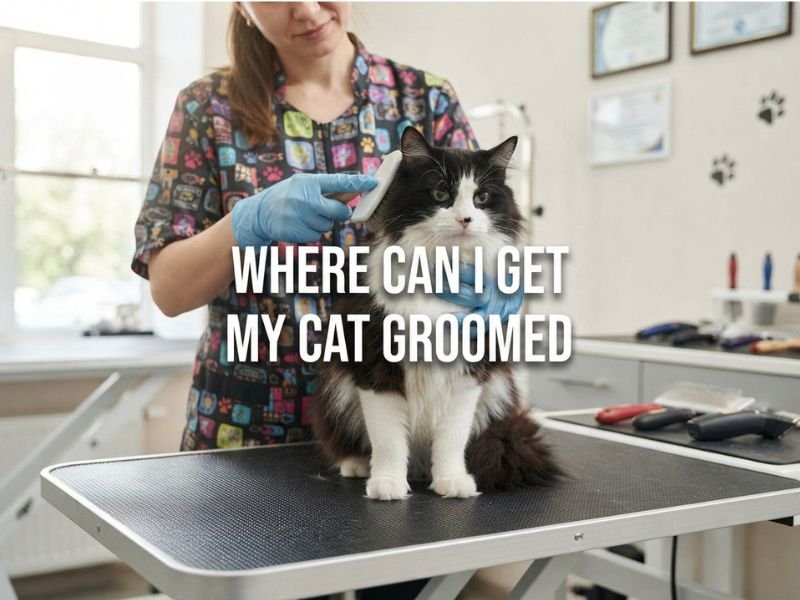
The best place to get a cat groomed is usually a cat-focused grooming salon, a professional groomer who regularly handles cats, or a mobile cat groomer who visits your home. Some veterinary clinics also offer grooming, especially for cats that are elderly, medically fragile, severely matted, or difficult to handle.
A general pet store grooming department may be suitable for a calm cat needing a basic nail trim or sanitary trim, but policies vary. Some locations groom dogs only, while others accept cats only during specific hours or with advance reservations. I would confirm the provider’s cat experience before booking rather than assuming a familiar pet chain offers the service.
Your choice should reflect your cat’s temperament and condition:
- Cat-only salon: Often a calm choice for cats that become frightened around barking dogs or busy pet-store traffic.
- Experienced all-pet groomer: Appropriate if the groomer routinely handles cats and can explain cat-specific procedures.
- Mobile cat groomer: Convenient for cats that dislike car rides or unfamiliar waiting rooms.
- Veterinary grooming: Better for cats with serious mats, skin disease, obesity-related grooming problems, pain, or a history of unsafe handling.
- At-home grooming: Reasonable for simple brushing and nail care when your cat is relaxed and you have suitable tools.
A groomer should never treat a cat exactly like a small dog. Cats have different stress signals, skin sensitivity, restraint needs, and tolerance for noise. Ask how the professional manages fear, biting, mat removal, drying, and breaks before scheduling.
What services do cat groomers provide?
Cat grooming can mean anything from a quick nail trim to a full haircut. A professional should discuss the requested service, inspect the coat, and tell you if the condition of the fur requires a different approach.
Brushing and de-shedding
Brushing removes loose fur, distributes natural oils, and helps identify mats, scabs, fleas, lumps, or irritated skin. A de-shedding service may reduce loose undercoat, but it does not eliminate normal shedding permanently.
Long-haired and dense-coated cats often need more frequent brushing than short-haired cats. However, even short-haired cats can develop tangles around the armpits, belly, collar area, and back legs. A groomer may recommend a home brushing routine after the appointment.
Mat removal
Mats are compacted areas of fur that pull on the skin. Small tangles may sometimes be combed out carefully, but tight mats should not be cut with household scissors. Cat skin is loose and can easily be pulled into a mat, making accidental cuts possible.
Severe matting may require clipping close to the skin. In some cases, the cat is too painful, frightened, or medically compromised for a routine grooming appointment. A veterinarian may need to assess the skin and discuss safe sedation or another controlled plan.
Haircuts and lion cuts
A sanitary trim removes excess fur around the rear and genital area. A partial trim may tidy the belly, legs, or problem areas. A lion cut removes much of the body coat while leaving fur around the head, feet, and sometimes the tail.
A haircut is not automatically healthier than a full coat. It may help a cat with recurring severe mats, fecal soiling, or an inability to groom effectively, but shaving can expose sensitive skin to sun, temperature changes, scratches, and irritation. I would ask the groomer what problem the haircut is intended to solve before choosing a style.
Nail trimming
Cat nail trims shorten the sharp tips of the claws without cutting into the quick, the sensitive inner portion containing blood vessels and nerves. A groomer can show you how much to remove and how often your cat may need trims.
Bathing and drying
Most healthy cats do not need routine baths because they clean themselves. A bath may be useful after exposure to a harmful substance, heavy grease, severe fecal contamination, or a coat that cannot be cleaned by brushing alone. Cats with certain skin conditions may also need a veterinarian-recommended shampoo.
Drying can be stressful. Ask whether the groomer uses a quiet drying method, towel drying, a kennel dryer, or another process. A cat should never be left unattended with unsafe heat or equipment.
Cat grooming options compared
| Option | Best for | Potential limitations |
|---|---|---|
| Cat-only salon | Routine grooming, nervous cats, long-haired cats | May have limited availability or higher prices |
| General pet grooming salon | Calm cats needing basic services | May be noisy or primarily designed for dogs |
| Mobile groomer | Cats that dislike travel or unfamiliar facilities | May cost more and serve a limited geographic area |
| Veterinary clinic | Medical concerns, severe matting, high-risk handling | Routine services may not be available at every clinic |
| At-home grooming | Brushing, simple nail trims, light maintenance | Not suitable for severe mats, aggressive resistance, or medical problems |
A mobile appointment can reduce travel stress, but being at home does not guarantee that a cat will cooperate. Some cats feel more defensive in familiar territory. A skilled mobile groomer should still have a plan for restraint, equipment, sanitation, and stopping the service if the cat becomes unsafe.
How to find a qualified cat groomer
Start with local searches such as “cat groomer near me,” “mobile cat grooming,” or “cat grooming at a veterinary clinic.” Then look beyond star ratings. Reviews can be helpful, but a provider’s direct answers are more useful for judging cat-specific competence.
Ask about cat experience
Ask how often the groomer handles cats, what coat types the groomer sees, and which services are offered. “All breeds” does not necessarily mean the provider has extensive cat experience. A groomer who mainly handles dogs may not be the best choice for a fearful or badly matted cat.
Ask about handling and stopping policies
A responsible groomer should be able to describe how the cat is introduced to the process and what happens if the cat becomes distressed. Ask whether the groomer uses breaks, minimal restraint, protective equipment, or a stop-service policy.
Some cats cannot be safely groomed while fully awake. A groomer should not administer sedatives. If medication or sedation may be necessary, that decision belongs to a veterinarian, and the grooming plan should be coordinated with the veterinary team.
Verify practical details
Before booking, confirm:
- Whether cats are groomed separately from dogs.
- Which services are included in the quoted price.
- Whether the groomer charges extra for mats, difficult handling, or excessive shedding.
- How long the appointment typically takes.
- What vaccines, health records, or flea policies apply.
- Whether the groomer accepts kittens, senior cats, or cats with medical conditions.
- What happens if the requested haircut is unsafe or cannot be completed.
- Whether you need to remain nearby or leave a contact number.
Pay attention to how the provider responds. Clear, specific answers suggest a more organized service. Pressure to book immediately, promises to remove every mat without assessing the coat, or casual claims that any cat can be forced through a haircut are reasons to look elsewhere.
How much does cat grooming cost?
Cat grooming prices vary by location, coat length, service type, cat size, coat condition, and handling difficulty. A basic nail trim usually costs less than a full haircut, bath, or severe mat removal. Mobile grooming and veterinary-based grooming may also carry additional fees for convenience, medical oversight, or specialized handling.
A price quote may change after the groomer sees the cat. Important factors include:
- Short, medium, or long coat.
- Number and severity of mats.
- Need for a sanitary trim or full haircut.
- Bathing and drying requirements.
- Flea treatment or heavy contamination.
- Time needed for a fearful, defensive, or unusually active cat.
- Travel distance for a mobile appointment.
- Extra work caused by skin problems or fecal matting.
Ask for an estimated range and a list of possible add-on charges. The cheapest appointment may not be the best value if it involves rushed handling or an inexperienced provider. At the same time, a high price does not prove that a groomer is qualified. I would compare cat experience, safety practices, communication, and total service details rather than price alone.
When should a veterinarian handle grooming?
A veterinary clinic or veterinary consultation is appropriate when grooming is connected to a health concern. Grooming can reveal problems, but a groomer is not a substitute for diagnosis or treatment.
Contact a veterinarian before grooming if your cat has:
- Severe or widespread matting.
- Open sores, bleeding, swelling, or painful skin.
- Suspected ringworm, mites, fleas, or another contagious condition.
- Grease, paint, chemicals, medication, or another potentially toxic substance on the coat.
- Fecal or urine contamination that has irritated the skin.
- Sudden inability to groom, a greasy coat, or a major change in coat quality.
- Significant arthritis, obesity, diabetes, heart disease, breathing problems, or other chronic illness.
- A history of extreme aggression, panic, or unsafe reactions during handling.
Older cats may stop grooming themselves because of arthritis, dental pain, weakness, or cognitive changes. A messy coat may therefore be a symptom rather than the main problem. The veterinarian can check for an underlying condition and decide whether medication, sedation, pain control, or a modified grooming plan is needed.
If a toxic substance is on the fur, call a veterinarian or animal poison service promptly instead of taking the cat directly to a routine groomer. A cat may ingest the substance while licking. Do not apply household cleaners, essential oils, or unapproved products to the coat.
How to prepare your cat for a grooming appointment
Preparation should reduce surprises rather than force the cat to tolerate an unfamiliar process all at once. If your cat has never been groomed, tell the provider exactly what handling your cat accepts at home.
Before the appointment
- Confirm the service, price range, arrival time, and expected duration.
- Tell the groomer about bites, scratches, panic, past grooming problems, and medical conditions.
- Do not give calming medication unless it was prescribed and explained by your veterinarian.
- Use a secure carrier for travel and place a familiar towel inside.
- Avoid putting a severely matted coat through a vigorous home brushing session.
- Follow the groomer’s feeding instructions, especially if a veterinary procedure may be involved.
Do not punish your cat for resisting brushing. Punishment can make the carrier, brush, and grooming area more frightening. Instead, keep handling sessions brief and stop before your cat reaches the point of panic.
At home between appointments
Regular maintenance often prevents a difficult grooming session. Use a brush suited to your cat’s coat, and begin with short sessions in a quiet place. Reward calm behavior. Check commonly missed areas, including behind the ears, under the front legs, around the collar, along the belly, and near the hindquarters.
Never use scissors to cut a mat close to the skin. If a comb cannot pass through the tangle easily, ask a professional for help. A mat that appears small on top may be attached tightly at the skin.
For nail care, touch the paws gently when your cat is relaxed. You can introduce the clippers gradually without trimming at first. If your cat struggles intensely, a groomer or veterinary technician can demonstrate safer handling.
Signs a grooming appointment is unsafe
Some grooming requests should be modified, postponed, or referred to a veterinary professional. A safe groomer should recognize limits rather than treating completion as the only goal.
Be cautious if a provider:
- Promises to finish every cat regardless of behavior or medical condition.
- Suggests using human medication or someone else’s sedative.
- Will not explain how mats, drying, or restraint are handled.
- Uses force as the primary response to fear or aggression.
- Wants to shave a cat without discussing the reason and possible skin exposure.
- Does not ask about health history, allergies, fleas, or previous reactions.
- Dismisses bleeding, painful skin, breathing changes, or extreme distress.
- Cannot tell you what happens if the service must stop early.
A cat may hiss, growl, freeze, swat, or attempt to escape because grooming feels threatening. Those signals should be taken seriously. A groomer may use appropriate protective techniques, but escalating fear increases the risk of injury and can make future care harder.
Common mistakes cat owners make
Waiting until the coat is severely matted
Long-haired cats can move from manageable tangles to painful mats quickly. Waiting can turn routine brushing into clipping or veterinary care. I recommend checking the coat on a regular schedule, even when it looks tidy from a distance.
Choosing a groomer based only on convenience
The closest salon may not accept cats or may have limited feline experience. Convenience matters, but handling skill matters more when your cat is fearful, elderly, or difficult to brush.
Assuming every cat needs a haircut
A haircut can solve particular problems, but it is not required for every long-haired cat. Consistent brushing may be enough for a healthy, cooperative cat. Ask what issue the haircut addresses and whether a partial trim would be safer or more useful.
Trying to remove tight mats with scissors
This is one of the most dangerous home grooming mistakes. Cat skin can be hidden inside the mat, and a quick snip can cause a deep laceration. Clippers handled by a trained professional are safer than scissors used at home.
Ignoring a change in grooming habits
A cat that suddenly stops grooming, develops dandruff, or becomes greasy may be experiencing pain or illness. Booking a haircut without investigating the change can delay needed care.
Frequently asked questions
Where can I get my cat groomed if local salons groom dogs only?
Look for a cat-only salon, a mobile cat groomer, or a veterinary clinic that provides feline grooming. Search specifically for cat grooming rather than general pet grooming, and call to confirm that the provider currently accepts cats.
Can a regular dog groomer groom my cat?
A dog groomer can groom a cat only if the groomer has meaningful feline experience and uses cat-appropriate handling, equipment, and drying procedures. Ask how often the groomer handles cats and whether cats are scheduled separately from dogs.
Is mobile cat grooming better than a salon?
Mobile grooming can be better for a cat that becomes distressed during car rides or in a busy salon. A salon may be preferable if it has a quiet cat-only area or if your cat is comfortable traveling. The groomer’s skill and safety plan matter more than the setting alone.
Can a groomer remove severely matted fur?
A groomer may be able to remove mats with clippers, but severe, painful, infected, or widespread matting should be assessed by a veterinarian first. A groomer should not promise a painless routine appointment without seeing the coat and evaluating the cat’s condition.
Does my cat need to be sedated for grooming?
Most routine grooming does not automatically require sedation. However, a frightened, aggressive, painful, or severely matted cat may need veterinary guidance. Only a veterinarian should prescribe or administer medication for grooming-related sedation or anxiety.
How often should I take my cat to a groomer?
There is no single schedule for every cat. Frequency depends on coat length, matting tendency, shedding, hygiene, age, mobility, and your ability to maintain the coat at home. A groomer can suggest an interval after evaluating the cat, but regular home checks remain important.
Can a groomer bathe my cat?
Yes, some cat groomers provide baths, but bathing is not necessary for every cat. It may help with heavy contamination or a veterinarian-recommended skin-care plan. Ask how the cat will be dried and what products will be used.
What should I do if my cat becomes aggressive during grooming?
Do not force the session at home. Tell the groomer about the behavior before the appointment and ask about a stop-service policy. If the reaction is severe or connected to pain, illness, or prior trauma, consult a veterinarian about a safer plan.
Conclusion
The best answer to where can i get my cat groomed depends on the service needed, your cat’s temperament, and the cat’s health. A cat-focused salon, experienced mobile groomer, or veterinary clinic can each be appropriate in different situations. I recommend confirming feline experience, handling practices, pricing, and health limitations before booking. With the right provider and regular coat checks at home, grooming can protect your cat’s comfort instead of becoming a stressful emergency.