What Size Sweater Does My Dog Wear? Guide to Measuring Your Dog
If you are asking, **what size sweater does my dog wear**, the safest answer starts with a tape measure, not a breed name. A Chihuahua, Poodle, or Labrador can have a very different body shape from another dog of the same breed. Even two dogs with the same weight may need different sweater sizes.
The key is to find a sweater that fits your dog’s body without rubbing, squeezing, or blocking movement. In the U.S., dog sweater sizes often range from XXS or XS for tiny dogs to XL, XXL, or larger sizes for big dogs. But these labels are not standard, so always check the brand’s own chart before you buy.

How Do I Know What Size Sweater My Dog Needs?
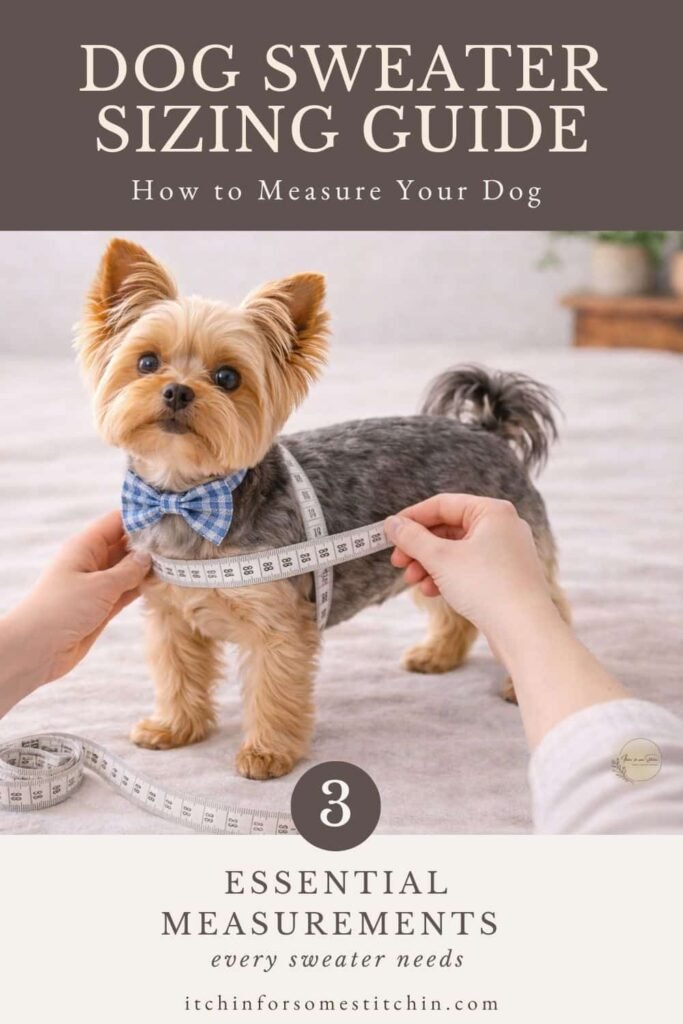
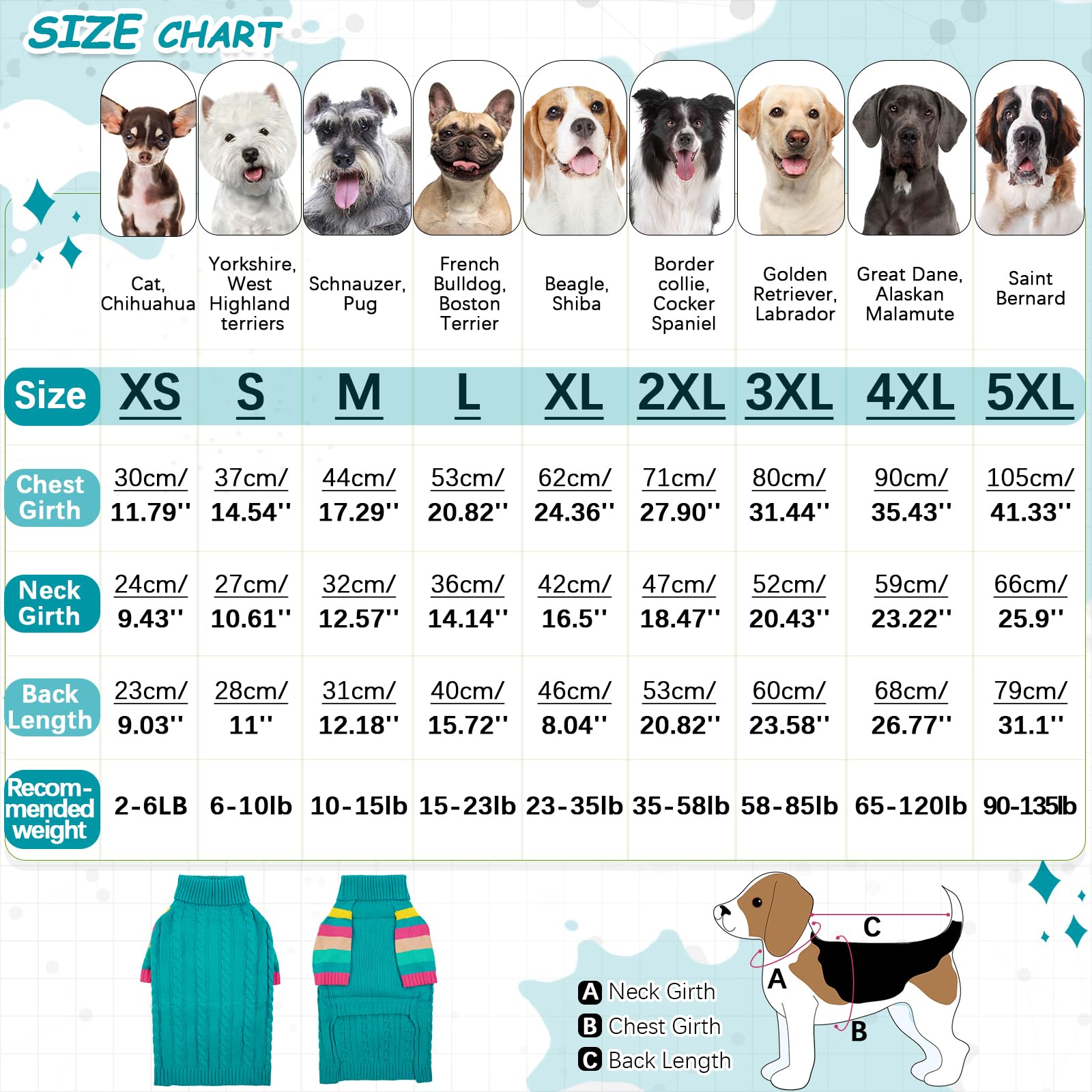
To find **what size sweater your dog wears**, measure three main areas: chest, back length, and neck. These measurements give you a much better starting point than weight alone. Your dog’s chest size is often the most important measurement because the sweater must fit around the widest part of the body.
Measure your dog while they are standing in a normal position. Keep the tape flat against the fur, but do not pull it tight. Write each number down in inches so you can compare it with the size chart.

- ✦ Chest girth
Wrap the tape around the widest part of your dog’s chest, usually just behind the front legs. Keep the tape snug but loose enough to avoid pressing into the coat.
- ✦ Back length
Measure from the base of the neck, near the shoulders, to the base of the tail. Do not measure all the way to the tip of the tail.
- ✦ Neck size
Measure around the lower part of the neck where the sweater collar will sit. Leave enough room for comfortable breathing and movement.
- ✦ Weight
Use weight as a secondary guide. It can help narrow the choices, but it should not replace body measurements.
Why Breed Alone Does Not Tell You the Sweater Size
Breed charts can be useful for a quick guess, but they cannot guarantee a good fit. Dogs within the same breed can have different chest widths, back lengths, body conditions, and coat thickness. This is why the answer to **what size sweater does my dog wear** should come from measurements first.
For example, a long-bodied Dachshund may need a different sweater shape from a dog with a similar weight but a short back. A lean Greyhound may also need a different cut from a stockier dog with the same weight.
- ✦ Body shape varies
Two dogs can weigh the same but have very different chest and back measurements.
- ✦ Breed charts are estimates
A breed may commonly fall into one size range, but individual dogs can fall outside that range.
How to Measure Your Dog for a Sweater
A soft sewing tape works best, but you can also use a piece of string and measure the string with a ruler. Ask your dog to stand on all four paws. Measuring while your dog is sitting or lying down can change the numbers.
Take each measurement twice if your dog moves around. Small differences are normal, but a large difference means it is worth measuring again. If your dog has thick or long fur, keep the tape close to the body without compressing the coat.

- ✦ Step 1: Measure the chest
Place the tape around the deepest part of the chest, just behind the front legs. Record the measurement in inches.
- ✦ Step 2: Measure the back
Start at the base of the neck and measure along the spine to the base of the tail.
- ✦ Step 3: Measure the neck
Measure the area where the sweater collar will rest. Do not pull the tape tightly.
- ✦ Step 4: Record weight
Write down your dog’s current weight if the brand includes weight in its size guide.
- ✦ Step 5: Compare with the chart
Compare every measurement with the brand’s chart. Choose the size based on the measurements that matter most for that sweater.
What If My Dog Is Between Two Sweater Sizes?
If your dog falls between two sizes, do not automatically choose the larger one. Look at the chest and back measurements first, then consider the sweater’s fabric and design. A stretchy knit may allow more room than a stiff coat.
When in doubt, a slightly roomier sweater is often more useful than one that restricts the chest or shoulders. However, the sweater should not hang so loosely that your dog can step into it, catch a paw, or become tangled.
- ✦ Check the chest first
If the smaller size is too narrow around the chest, move up a size.
- ✦ Check the back length
Make sure the larger size does not extend too far over the tail or interfere with bathroom needs.
- ✦ Consider the fabric
Stretchy fabrics may fit a wider range of measurements than rigid materials.
Dog Sweater Size Chart: How to Read One
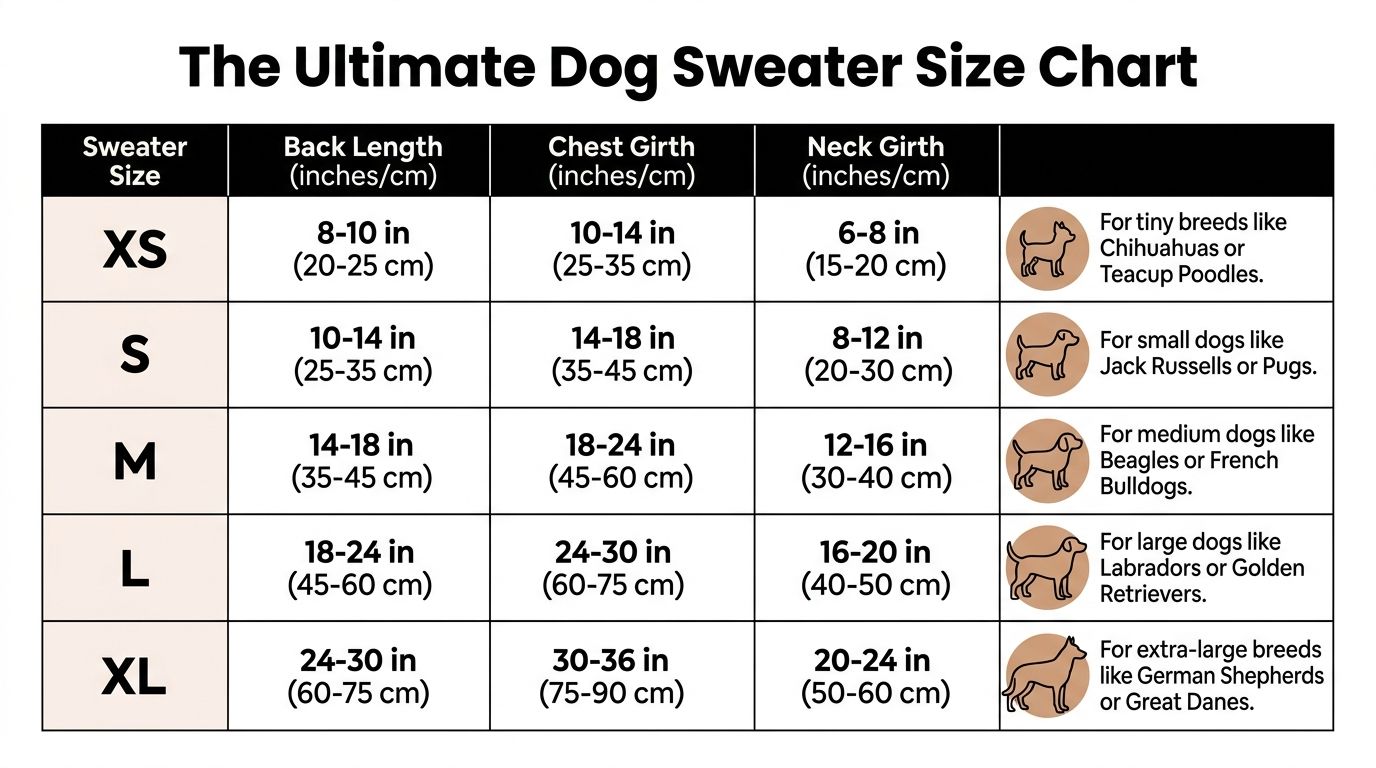
A dog sweater size chart may list XS, S, M, L, XL, and XXL. The letters look simple, but the actual measurements can vary a lot between brands. One company’s medium may be another company’s large.
When checking **what size sweater does my dog wear**, focus on the numbers beside the size label. Look for chest girth, back length, neck size, and weight. If a chart gives a measurement range, your dog’s measurements should fall comfortably inside that range.
- ✦ XXS or XS
Often used for very small dogs, puppies, and toy breeds. Always check the actual chest and back measurements.
- ✦ Small
Common for smaller companion dogs, but body shape still matters more than the label.
- ✦ Medium
Often used for mid-sized dogs, but there is no universal medium size across brands.
- ✦ Large
Often covers larger small dogs and medium-to-large dogs, depending on the brand.
- ✦ XL or XXL
Often used for large and giant dogs. Check chest girth closely because large dogs can have very different body shapes.
Why Dog Sweater Sizes Are Not Universal
There is no single sizing system that every dog clothing company follows. One brand may base its size mainly on chest girth, while another may give equal weight to back length and neck size.
This means you should not assume that a sweater marked medium will fit your dog because another medium sweater did. Treat every new brand as a new sizing system and check its measurements before ordering.
- ✦ Read the brand chart
Use the measurements supplied by the company that makes the sweater.
- ✦ Ignore the letter alone
XS, S, M, L, and XL are labels, not exact industry-wide measurements.
What Size Sweater Does My Dog Wear by Breed?
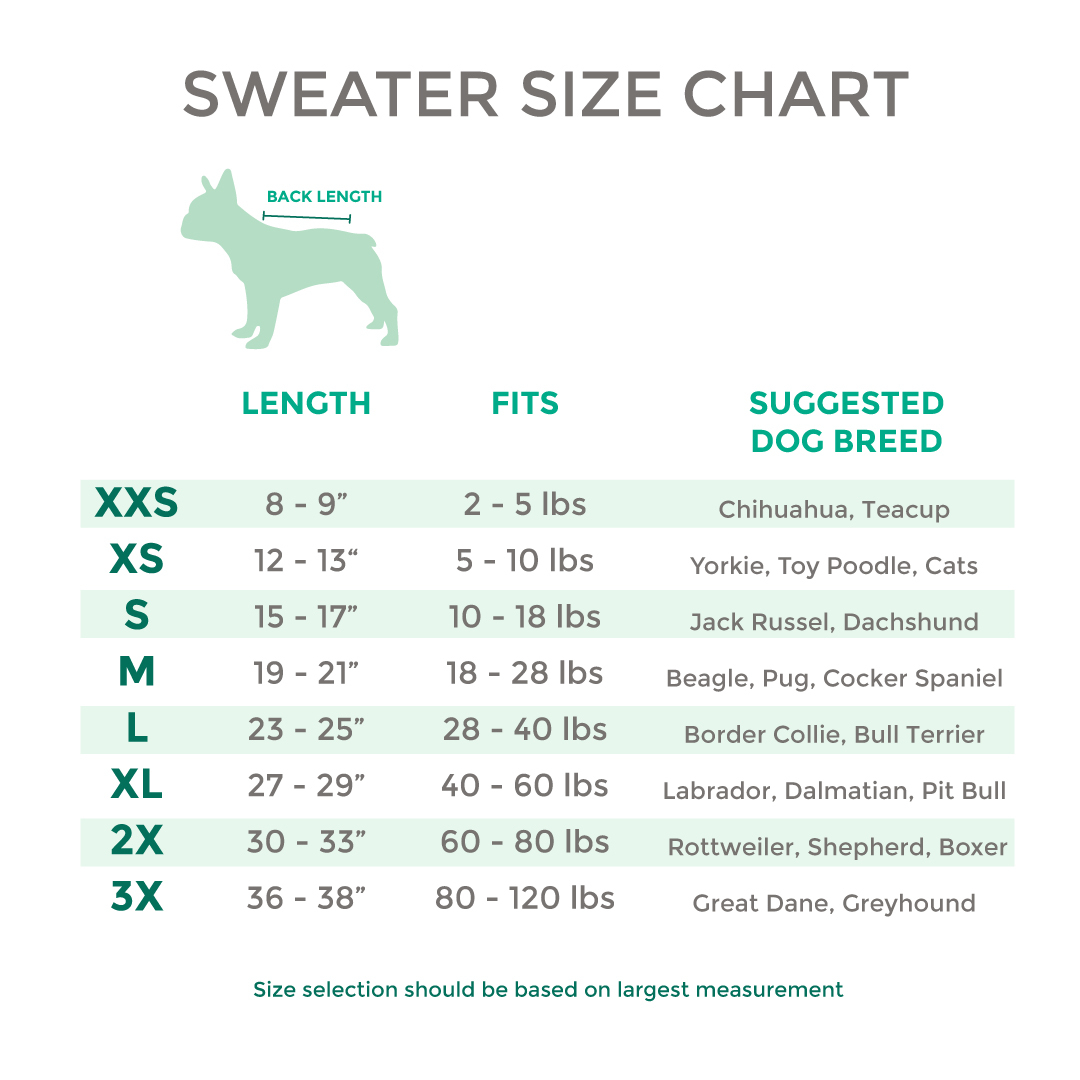
Breed can give you a rough starting point when you are shopping, but it should never be the only way you choose a sweater. Small breeds often need XS or small sizes, while medium and large breeds may need medium through XXL. The exact choice depends on the dog’s measurements and the sweater’s cut.
For example, a Chihuahua may need an XXS or XS, while a Beagle may often fall around small or medium. A Labrador Retriever may need a large or XL, while a Great Dane may require an extra-large or specialty size. These are only starting points, not guaranteed sizes.
- ✦ Chihuahua
Often needs an XXS or XS sweater, but measure the chest and back before buying.
- ✦ Yorkshire Terrier
Often falls in an XS or small range, depending on body length and chest size.
- ✦ Dachshund
May need a sweater designed for a long back rather than a standard small-dog cut.
- ✦ Beagle
Often falls around small or medium sizes, with chest girth being especially useful.
- ✦ Cocker Spaniel
May need a medium-sized sweater, but coat thickness and body shape can affect the fit.
- ✦ Golden Retriever
Often needs a large or XL sweater, depending on chest girth and back length.
- ✦ Labrador Retriever
Often needs a large or XL size, but individual measurements should decide the final choice.
- ✦ Great Dane
May need an XL, XXL, or specialty sweater designed for a very large chest and long body.
Why Two Dogs of the Same Breed May Need Different Sizes
Dogs within one breed can differ in size, age, body condition, muscle, and coat. A young dog may also grow out of a sweater quickly. That is why breed-based sizing should be treated as a rough estimate.
If you are searching **what size sweater does my dog wear by breed**, use the breed as your starting point, then confirm the answer with a tape measure. This simple step can prevent a poor fit and an unnecessary return.
- ✦ Age matters
Puppies can grow quickly, so their sweater size may change within a short time.
- ✦ Build matters
A lean dog and a broad-chested dog of the same breed may need different sweater sizes.
How Should a Dog Sweater Fit?
Knowing **what size sweater does my dog wear** is only half the job. The sweater also needs to fit correctly once it is on your dog. It should feel secure without squeezing the neck, chest, belly, or legs.
Your dog should be able to walk, sit, lie down, turn, and raise the front legs without trouble. The sweater should not rub the skin, limit breathing, or cause your dog to change the way they move.

- ✦ Neck
The collar should sit comfortably without pressing against the throat.
- ✦ Chest
The sweater should cover the body without squeezing the ribs or restricting normal breathing.
- ✦ Shoulders
Your dog should move both front legs freely without the fabric pulling across the shoulders.
- ✦ Back
The sweater should cover the back well without hanging far past the base of the tail.
- ✦ Belly
The lower edge should not block urination or become wet and dirty during normal bathroom trips.
Signs a Sweater Is Too Small
A sweater may be too small if it leaves deep marks in the fur or skin, pulls across the chest, or makes movement look stiff. Your dog may also try to remove it or show clear discomfort.
Remove a sweater that causes pain, rubbing, breathing problems, or restricted movement. A warm garment is not useful if your dog cannot wear it comfortably.
- ✦ Tight chest
The fabric pulls hard across the ribs or chest.
- ✦ Restricted movement
Your dog cannot walk or move the front legs normally.
- ✦ Skin pressure
The sweater leaves strong marks or rubs the skin.
Signs a Sweater Is Too Large
A sweater can also be a problem when it is too loose. Excess fabric may catch on objects or get in the way of your dog’s legs. A loose sweater may also twist while your dog walks.
The sweater should stay in place during normal movement. If it shifts, bunches, or hangs far below the body, try a smaller size or a different design.
- ✦ Loose armholes
Large openings may let a front leg slip into the sweater.
- ✦ Excess fabric
Extra material can bunch under the belly or around the legs.
- ✦ Poor coverage
A loose sweater may shift instead of staying over the dog’s back.
Should You Size Up or Size Down?
If your dog’s measurements fall between two sizes, the right choice depends on the sweater design. Look at the chest, back, and neck ranges instead of choosing based only on the label. A sweater with stretch may allow a little more flexibility than a stiff coat.
If the smaller size is tight around the chest or shoulders, sizing up is usually the safer direction. But if the larger size has very long sleeves, a very loose neck, or too much belly fabric, a different cut may work better than simply choosing a larger sweater.
- ✦ Choose larger when the chest is tight
A sweater should never squeeze the chest or limit normal breathing and movement.
- ✦ Consider a different cut
Dogs with long backs, broad chests, or unusual body shapes may need a specialty design.
- ✦ Check return rules
When ordering online, check the seller’s size exchange and return policy before buying.
What About Thick Fur?
A thick coat can change how a sweater fits. Do not compress a heavy coat just to make the sweater seem smaller. Instead, follow the brand’s guidance for dogs with thick fur and check that the garment does not mat or pull the coat.
For dogs with very dense or long hair, look for a sweater with enough chest room and smooth inner seams. Regularly check the fur under the neck, armpits, and belly for rubbing or tangles.
- ✦ Do not squeeze the coat
The sweater should fit the dog, not force thick fur tightly against the skin.
- ✦ Check friction areas
Pay extra attention to the neck, chest, armpits, and belly.
Common Mistakes When Choosing a Dog Sweater Size
Many sizing problems happen because shoppers rely on one number or one label. The most common mistake is buying a sweater based only on weight or breed. Another common mistake is assuming that the same size label means the same thing across different brands.
Take a few minutes to measure your dog before you order. This is especially important when buying online because you cannot test the sweater on your dog first.
- ✦ Using weight alone
Weight does not show where your dog carries that weight or how long the body is.
- ✦ Using breed alone
Breed estimates cannot account for individual body shape.
- ✦ Ignoring the back length
A sweater can fit the chest but still be too short or too long for the back.
- ✦ Choosing by the size letter
A medium in one brand may be much smaller or larger than a medium in another.
- ✦ Forgetting coat thickness
A thick coat can affect the space needed inside the sweater.
- ✦ Not checking movement
A sweater can match the measurements but still have a poor cut that limits movement.
A Simple Final Fit Check
After putting the sweater on your dog, watch them walk for a few minutes. Check the neck, chest, shoulders, belly, and back. The fabric should stay in place without pulling or bunching.
Then remove the sweater and inspect the fur and skin. Look for red areas, pressure marks, damp spots, or tangled hair. This quick check can help you catch a poor fit before your dog wears the sweater for a longer period.
- ✦ Walk test
Make sure your dog can walk and turn without changing their normal movement.
- ✦ Movement test
Check that the front legs and shoulders have full freedom of movement.
- ✦ Skin and coat check
Look for rubbing, pressure marks, moisture, or tangles after use.